
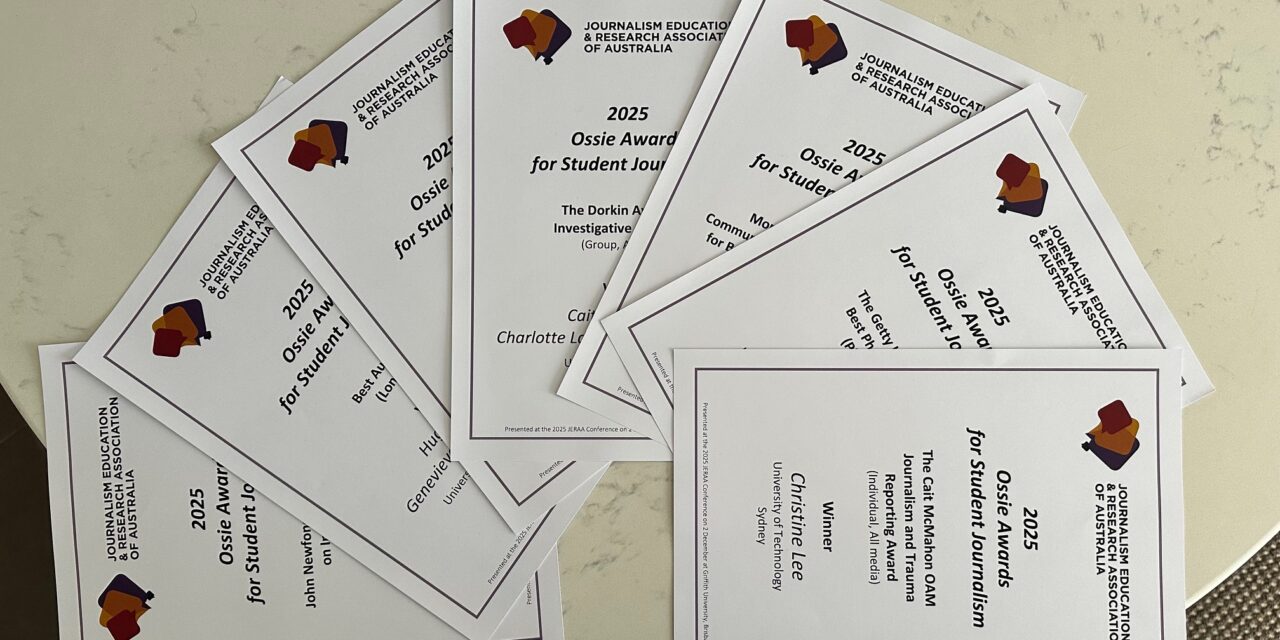
UTS journalism students have picked up a swag of awards at the JERAA Ossie’s, including for investigative journalism, photojournalism, climate change reporting, data journalism, trauma reporting, Indigenous reporting and podcasting.
The Journalism Education and Research Association of Australia annual awards, which this year was held by Griffith University at the Brisbane Powerhouse, is the largest and most contested competition in Australia and New Zealand for student journalism.
Lexie Fenner won the Getty Images Award for Best Photojournalism for her ‘100 Year Index’ photo essay on Joseph Coorey, with judge Chris McGrath from Getty Images commenting: “A quiet story that intrigues the viewer and holds their attention through good use of compositions, details, depth of field and use of light… the images show intimacy that helps to inform the viewer with each image.”
Christine Lee won the Cait McMahon OAM Journalism and Trauma Reporting Award for her story ‘Amy moved 50 times in three years: Australia’s hidden homelessness crisis’. Judge Caroline Winter, a TV and podcast producer, said: “With lived experience, expert analysis and national data, Christine balances trauma, empathy and dignity. It is a moving, accurate piece that advances public understanding of violence, displacement and community impact for an often-hidden face of our society.”
Hugh Phillips and Genevieve Blandin de Chalain won the Best Audio Story (longform) for their 50-minute podcast ‘Stateless’ which looked at the lives of Myanmar refugees who had fled the civil war. AccessMediaNZ judge Sasha Borissenko said it displayed “exceptional field reporting with engaging historical context and confident storytelling”.
“Vivid interviews and skilful production illuminated the human cost of Myanmar’s refugee crisis with empathy, clarity, and editorial maturity,” she added.
Bridget Ross won the Monash Climate Change Communication Research Hub Award for Best Climate Change Reporting for her feature on sustainability fashion designer Marina Debris – ‘The Rubbish Artist’.
Judge Amelia Pearson, from the Monash Climate Change Communication Research Hub, said: “Bridget Ross’ elegant writing paired with her choice of protagonist renders our everyday waste unexpectedly intriguing and sexy.
“The story blends a compelling narrative with striking imagery and a clear orientation towards practical solutions for consumers, without the climate message feeling overt.”

JERAA Awards host and organiser Jeanti St Clair. Photo: Central News.
Students bagged two investigative awards, with Caitlin Maloney, Charlotte Laidlaw and Abbey Mitchell winning the Dorkin Award for Investigative Journalism (by a group) for their story ‘Are women being needlessly prescribed the pill?’, while Maloney also won the Best Data Journalism award for her article ‘Shocking drop in aged care COVID vaccinations’.
Judge Alison Sandy, from Seven, said of the team award: “A well-written, compelling and unambiguous investigative report that drew you in straight away. Highly informative and clear in its purpose. Additionally, given the limited information, Caitlin Maloney, Charlotte Laidlaw and Abbey Mitchell generated their own survey and garnered 80 respondents.”
Of the data award judge Miguel D’Souza commented: “Caitlin Maloney’s data journalism story establishes a clear and relevant data-led context for a shocking mismanagement of COVID in aged care.
“Her narrative logically guides the reader through complex statistics with clarity. The integration of original graphics and balanced testimony of facility managers to personalise this story and demonstrates excellent editorial judgement.”
Lilas-Mae Njoo was highly commended in the John Newfong Prize for Reporting on Indigenous Affairs for her story ‘Risk to Indigenous languages without more funding’.
Judge Bronte Charles from NITV and SBS said Njoo’s article excelled at “combining statistical context, expert insight, and compelling storytelling to highlight the urgent need for investment in Indigenous language preservation”.
She added: “The article personalises the issue while connecting it to global examples, making the stakes clear and immediate. The reporting balances policy, community impact, and cultural significance, demonstrating the power of journalism to inform and inspire action.”
Awards were shared around 15 universities with University of Melbourne, UNSW, RMIT and Monash faring particularly well, while there was also a strong showing from New Zealand universities Auckland University of Technology, Murdoch University, University of Canterbury and Massey University of New Zealand. La Trobe University, University of Newcastle, Curtin University, Bond University, Deakin University and University of South Australia all picked up awards, underlining the strength of journalism programmes across Australia.
Charlotte Wilkes from RMIT won the marquee award for Student Journalist of the Year, with Newcastle Uni’s Blair Wise the runner-up, and Monash University picking up Best Publication.
UTS lecturer and Central News editor Martin Newman said: “This is a strong result for our students and a well deserved one that the whole student body and faculty should be proud of.
“We had a lot of students nominate with great stories, videos and other formats, and we’re always blown away by the depth of talent. Many of the entries that didn’t win we thought were shoo-ins, which goes to show how strong competition around Australia and New Zealand is, and of the incredible quality of student journalism in this country.”
For JERAA’s full results click HERE.
Main image by Central News.


